
When the World Trembles, the Soul Is Being Asked to Anchor
Jan 12, 2026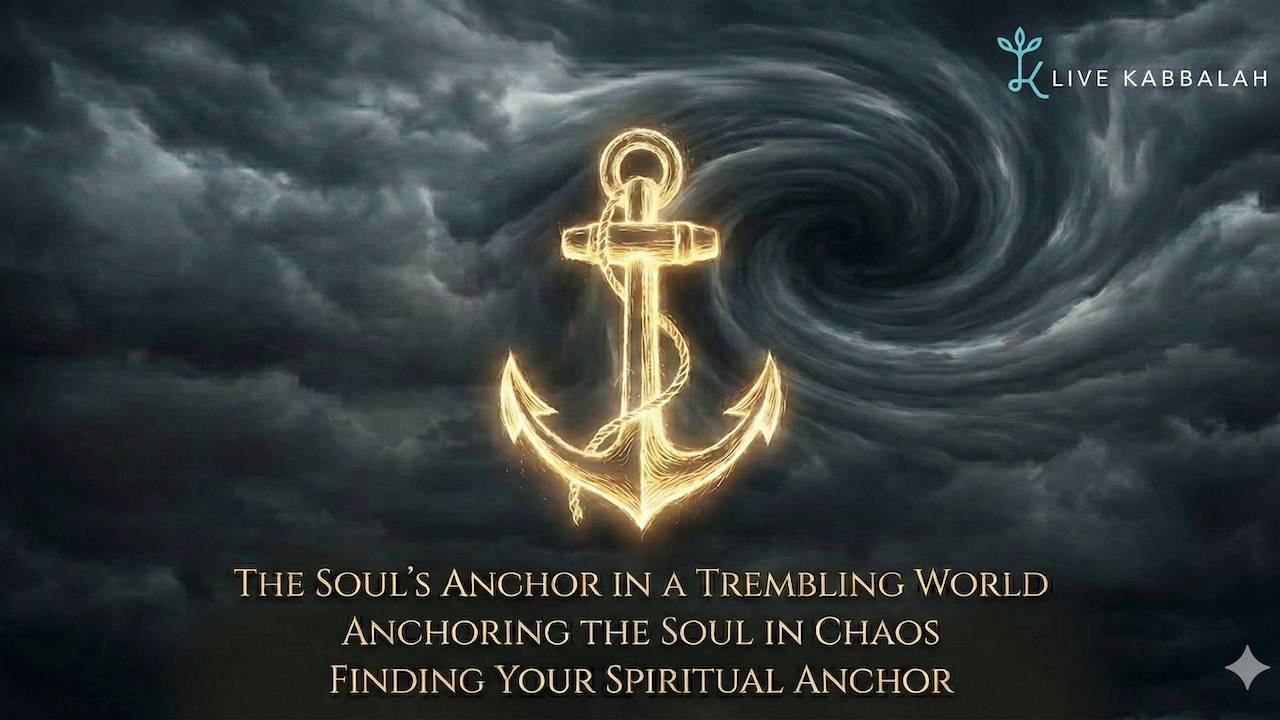
A Rumbling That Chazal Already Described
By Rabbi Amichai Cohen: From our Lightwarrior class
There is a passage in the Talmud (Sanhedrin 98) that speaks about end-of-days upheaval, describing conflict involving Persia and Rome, and how that turbulence is part of the “rumbling” that precedes Mashiach.
I am not writing this to turn Torah into headlines. Torah is not a news feed. But Chazal did teach that history has patterns, and that the soul can learn how to stand inside those patterns without collapsing into fear.
Sometimes the external shaking is a mirror of an internal shaking. When the world shakes, the question becomes: what is being asked of me now?
Shovavim: The Spiritual Season of Deep Work
Right now, we are in the time known as Shovavim, the weeks of Shemot through Mishpatim. These parshiyot carry the story of exile and redemption: constriction, oppression, resistance, miracles, the splitting, the wilderness.
Shovavim is not only historical. It is seasonal. It is spiritual.
Nature itself teaches it. In winter, the world contracts. Life retreats into roots, into soil, into inner biology that adapts to cold. Whether we live in a cold climate or not, there is still an inner winter that many people feel: a cocooning, a turning inward, a quieter world.
And here is the paradox: precisely when it feels darkest, the greatest transformation can occur. The stirring of the pot happens when things look still on the surface. The exile narrative is not only about suffering. It is also about the hidden labor that creates birth.
Redemption often comes with contractions.
So if something is coming up for you now, do not rush to bypass it. Honor it. Face what you have been avoiding. Not with self-attack, but with honesty and courage. Shovavim is an invitation to inner Exodus.
Happiness, Joy, and the Mystery of Mixed Feelings
One of the most human parts of our conversation was about happiness.
Many people carry a pattern: “I will be happy when…”
When something changes. When something resolves. When I reach a certain place. When life stops demanding.
But life does not work like that. And more importantly, the soul does not thrive that way.
There is a deeper word: simchah, joy.
Joy is not the absence of sadness. Joy can coexist with sorrow. A person can feel pain and still experience gratitude, meaning, tenderness, even laughter. Someone shared a memory of being in mourning and still attending a family celebration, feeling sadness and warmth at the same time. That mixture is not hypocrisy. It is wholeness.
We are not built to feel one dimension at a time. We are built for polarities.
And this is where inner work becomes practical: not forcing yourself to be “happy,” but learning how to be present and spacious enough to hold more than one emotional truth at once.
Moshe’s Secret: Leadership Begins in Humility
Moshe did not begin as a confident leader. He began as someone who saw his limitations clearly.
He said, “I cannot speak.”
He said, “Send someone else.”
He felt small.
And Hashem’s response was not, “You are perfect.” Hashem’s response was, “It is not about your perfection. It is about your mission.” Hashem gives Moshe support, partnership, and a path forward. Moshe learns that leadership is not a performance. It is an inner transformation.
Tanya teaches that every Jew has a Moshe within. An inner Moshe means there is a point inside you that can lead you, even when waves are high. It is an anchor-point, not a mood.
When you connect to that inner Moshe, you stop relating to yourself as only a victim of circumstances. You begin relating to life as a mission.
Not because you understand everything. Not because you control everything. But because you are willing to serve something higher than your fear.
Anger, Hate, and the Nervous System Alarm
One of the most poignant moments was when someone shared how much hate he felt building inside, and how frightening that felt to him.
First: awareness is already a gate of healing. When a person can say, “This is inside me and I do not want it,” that honesty itself is a spark.
Anger often comes from feeling a lack of control. A child loses control and erupts. An adult loses control and the nervous system flares. When anger intensifies, it can become hatred, which is often anger that has settled into identity.
But the key insight is this: much of what we call “the outside world” is experienced through the nervous system. The nervous system interprets threat, predicts danger, and then the mind builds stories around that alarm.
So part of redemption is learning regulation. Grounding. Breath. Returning the mind to the heart. Returning the heart to faith. Returning the body to safety.
This is not denial. This is inner strength.
Because if the inner world is on fire, the outer world will feel like an enemy. If the inner world is anchored, the outer world becomes a place where you can respond rather than react.
The “Anchor” Practice: One Word That Holds You
Here is a simple practice we committed to:
Choose one word for the day.
Sit with it for 5–10 minutes in the morning.
If possible, repeat for 5 minutes at night.
Not as an assignment. As a merit.
The word becomes an anchor. When the day storms, the word pulls you back to center.
Examples:
-
Shalom
-
Emunah
-
Savlanut (patience)
-
Bitachon (trust)
-
Ahavah (love)
-
Y-H-V-H (the awareness of Hashem’s presence)
You can even write the word in Hebrew, look at the letters, and meditate on what each letter suggests. Watch how the mind wanders, and gently return to the word. Over time, you will notice something profound: new pathways open. The mind becomes more spacious. The heart becomes less reactive. This is one of the gifts of neuroplasticity: you are not trapped inside yesterday’s patterns.
It is small. It is simple. It is powerful.
And sometimes simplicity is the highest wisdom.
There is a kind of “holy simplicity” that does not need to win every argument, prove every point, or predict every outcome. It preserves energy. It stays anchored.
The Etrog and the Secret of the Seasons
We spoke about the Etrog as a symbol of resilience. The Etrog can remain on the tree through multiple seasons. It holds winter, spring, summer, and fall. It endures shifts.
That is what inner wholeness looks like. Not clinging to one season. Not saying “I only like summer.” Not building a spiritual identity around comfort.
Wholeness is the capacity to hold the sun and the wind, the calm and the storm, the clarity and the unknown, while staying connected to the One who guides all seasons.
We are also approaching Tu BiShvat, the renewal-point of the trees. There is a deep prayer there: for healing, for the fruit of our lives, for the medicine of creation, for sweetness that comes after winter.
So What Are We Supposed to Do Right Now?
Here is the answer, as simply as I can say it:
Do the inner Exodus.
Do not surrender your mind to panic.
Do not surrender your heart to hatred.
Do not surrender your soul to despair.
Face what is coming up inside you with courage. Retreat inward in a healthy way, like nature does in winter, so that something new can be born.
Drop an anchor each morning. Choose a word. Breathe with it. Carry it. Return to it.
And remember: the goal is not to feel one thing only. The goal is to become whole enough to hold polarities, and anchored enough to keep walking.
May we hear good news.
May we be protected.
May we strengthen our emunah.
And may we turn this season of shaking into a season of redemption, inside and out.


